
Technical evidence note
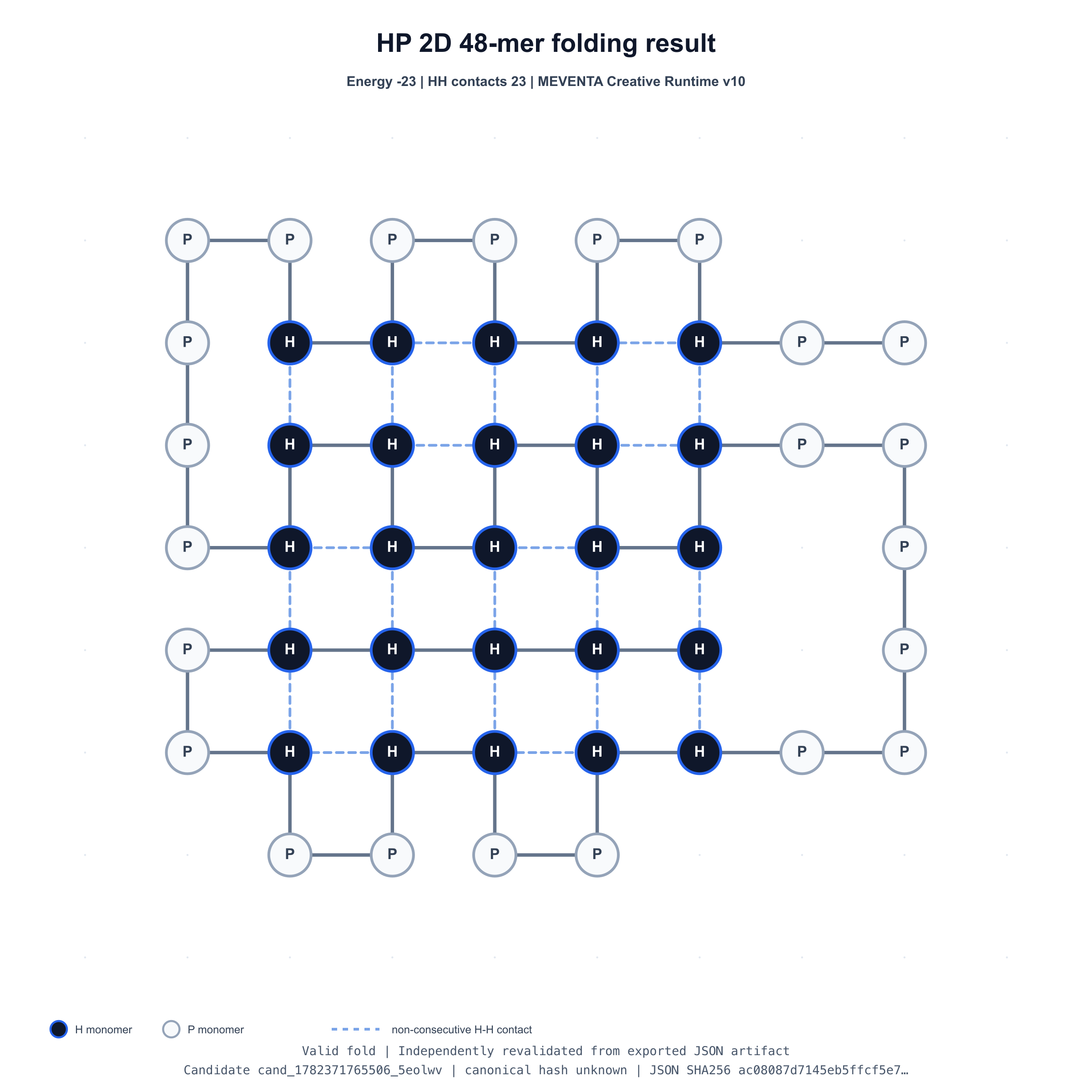
HP2D 48-mer -23 folding result.
MEVENTA Creative Runtime v10 produced a valid coordinate artifact for the classic HP2D 48-mer benchmark sequence with energy -23.
The result was exported as JSON coordinates, rendered from the artifact, and independently revalidated.
Claim
What is claimed.
MEVENTA Creative Runtime v10 produced a valid coordinate artifact for the HP2D 48-mer sequence with energy -23, corresponding to 23 non-consecutive H-H contacts.
This matches the best-known reported energy level for this benchmark sequence.
Validation
- Energy: -23
- H-H contacts: 23
- Valid fold: true
- Violations: 0
- Sequence length: 48
- Coordinates: 48
Run reference
Candidate:
cand_1782371765506_5eolwv
Final -23:
cycle 899 / point 11274
Run setup
Local MacBook run. No benchmark-specific pretraining dataset or model checkpoint was used for this run.
Boundaries
What is not claimed.
- This is not an AGI claim.
- This is not a general protein-folding claim.
- This is not a compute-normalized benchmark comparison.
- This is not a claim that HP2D is equivalent to biological protein folding.
- This is not a claim that MEVENTA outperforms every published method.
Evidence package
Open evidence package.
The package contains the original JSON artifact, SVG/PNG/PDF figures, validation JSON, run log, used source files and SHA-256 hashes.
Literature context
Framed without overclaim.
Yang et al. report the same -23 energy level for the Istrail 48mer using an LSTM-DQN approach. The comparison here is energy-level parity on the same benchmark sequence, not a compute-normalized equivalence claim.
Liang and Wong's Evolutionary Monte Carlo work is a classical reference point for HP-lattice folding simulations.